Filtration & Oil Purification Industry
Development of Specialty Thermoplastic Additives for Oil Filtration Systems A Case Study in Collaborative Materials Supply for Industrial Filtration Applications
Authors: Howard Bradshaw and Thomas A. Guerriero, PhD
Abstract
This case study examines a collaborative supply relationship between a specialty thermoplastic additive manufacturer (hereinafter "the Compound Manufacturer") and a manufacturer of advanced bypass oil filtration systems (hereinafter "the OEM"). The project, conducted from 2011 through 2014, focused on supplying custom masterbatch formulations to enhance the performance and reliability of filtration products serving heavy-duty applications. The collaboration achieved consistent quality assurance and reliable supply chain performance over multiple years, demonstrating the feasibility of specialized additive solutions in demanding industrial environments. The case illustrates the importance of quality control protocols, confidentiality frameworks, and sustained technical partnerships in industrial component supply relationships.
Keywords: thermoplastic additives, oil filtration, masterbatch formulations, industrial filtration, quality assurance, supply chain partnership, collaborative manufacturing, time-release additives, liquid additive incorporation
1. Introduction and Industry Context
1.1 The Imperative for Oil Purification in Heavy-Duty Applications
Advanced bypass oil filtration systems play critical roles in maintaining equipment reliability and extending service intervals across military, marine, mining, and industrial applications (Fitch, 2001; Williamson et al., 1990). These systems operate under demanding conditions where filtration media must maintain performance across wide temperature ranges, resist chemical degradation from lubricants and hydraulic fluids, and provide consistent flow characteristics under cyclic loading. The reliability of filtration systems directly impacts equipment uptime, maintenance costs, and operational safety in safety-critical applications.
The filtration media within these systems requires specialized modification to achieve target performance characteristics. Thermoplastic additives and property modifiers enable precise control over material behavior, including flow properties, density, and processing characteristics essential for manufacturing consistency (Grellmann & Seidler, 2007).
1.2 Time-Release Additive Systems for Fluid Preservation
A critical advancement in filtration technology involves the development of time-release additive systems dispersed within polymer matrices. The product supplied to the OEM represents a sophisticated "time-release" additive system in which proprietary functional additives are dispersed into a polypropylene matrix. These pellets are utilized by the OEM "as is" in the filter media, where they act to time-release a specialized antioxidant system to preserve fuel and oil life range. As oil or fuel washes over these pellets, they release minute quantities of the proprietary antioxidant blend in a controlled, time-release fashion, providing continuous protection against oxidative degradation.
The proprietary antioxidant blend was liquid at room temperature, presenting significant handling and incorporation challenges for many compounders. Liquid additives can be problematic to handle and uniformly disperse into polypropylene matrices using conventional compounding equipment. The Compound Manufacturer employed a novel approach to ensure that the liquid antioxidant additives were delivered consistently and uniformly into the polymer matrix, overcoming the technical barriers that often limit the use of liquid functional additives in thermoplastic applications.
1.3 Quality Assurance in Specialty Additive Supply
Industrial filtration applications demand rigorous quality control to ensure batch-to-batch consistency and performance predictability. Masterbatch formulations—concentrated additive packages dispersed in carrier resins—require precise control over physical and chemical properties including melt flow characteristics, pellet geometry, moisture content, and density (Vogel, 1996). Certificate of Analysis documentation provides traceability and quality verification for each production lot, enabling customers to validate material specifications against application requirements.
Supply relationships in this sector operate under stringent confidentiality protections, as additive formulations often represent proprietary competitive advantages for both the compound manufacturer and the end-use application (Bessen & Meurer, 2008).
1.4 Research Objectives
This case study analyzes the collaborative supply relationship for specialty masterbatch products in oil filtration applications. The research questions include: What quality assurance protocols enable consistent supply of specialty thermoplastic additives for demanding industrial applications? How do confidentiality frameworks facilitate information exchange while protecting proprietary formulations and processing knowledge? What factors contribute to sustained supply relationships in specialty chemical markets? How can collaborative partnerships between additive manufacturers and filtration system OEMs ensure reliable performance in safety-critical applications? How can liquid functional additives be effectively incorporated into polymer matrices to enable time-release functionality?
2. Methodology and Data Sources
This case study employs qualitative, document-based research methodology drawing upon primary source materials including: Mutual Confidentiality Agreement (July 2011); Certificate of Analysis documentation (September 2018); Technical correspondence and quotation documentation (April 2014); and Internal technical documentation. The analysis maintains confidentiality of proprietary formulation details, specific product codes, and commercial terms through anonymization consistent with the confidentiality obligations documented in the underlying agreements. This approach aligns with established case study research protocols in industrial and organizational contexts (Yin, 2018; Eisenhardt, 1989).
3. Case Background and Organizational Context
3.1 The Compound Manufacturer Profile
The Compound Manufacturer operated as a specialty thermoplastic compounder focused on developing modified polymer formulations and additive masterbatches for demanding industrial applications. Based in the southeastern United States, the organization specialized in creating custom additive packages to enhance the performance characteristics of base polymer resins. The company's technical capabilities included twin-screw extrusion compounding, custom additive masterbatch development, materials testing and characterization, and application-specific formulation optimization.
The organization positioned itself as a solutions provider capable of delivering precise material specifications through controlled manufacturing processes and rigorous quality assurance protocols. The company's expertise in handling difficult-to-process liquid additives and dispersing them uniformly into polymer matrices represented a distinctive technical capability that enabled the time-release functionality required by the OEM.
3.2 The OEM Profile
The OEM specialized in manufacturing advanced bypass oil filtration systems for heavy-duty equipment applications, including military vehicles, marine engines, mining equipment, and industrial machinery. The organization's filtration technology addressed critical equipment protection needs where oil purity directly impacts operational reliability and service life.
The OEM maintained sophisticated quality requirements for component materials, requiring documented verification of physical and chemical properties for all supplied materials. The organization's supply chain priorities emphasized consistency, reliability, and technical support for specialized material requirements.
3.3 Initial Engagement and Relationship Development
The collaborative relationship originated from the OEM's requirement for specialized property modifiers to enhance filtration media performance. Initial discussions focused on developing supply arrangements that would ensure consistent quality, documented specifications for each production lot, reliable delivery schedules, and technical support for application optimization.
The engagement moved rapidly from initial technical inquiry to formal collaboration under confidentiality protections, reflecting the OEM's immediate need for qualified supply partners and the Compound Manufacturer's readiness to meet specialized requirements. The Compound Manufacturer's demonstrated capability to handle liquid antioxidant systems and disperse them uniformly into a polypropylene matrix was a critical factor in the OEM's supplier selection.
4. Collaborative Framework and Governance
4.1 Confidentiality Agreement
The collaboration operated under a Mutual Confidentiality Agreement executed in July 2011. This agreement established the legal framework for information exchange while protecting each party's proprietary interests. Key provisions included:
Definition of Confidential Information: The agreement encompassed all data and information of technical, engineering, operational, business, or economic nature, specifically including formulations for products and related additive packages, processes and processing equipment, product samples and production quantities, and the existence and nature of activities under the agreement.
Use Limitations: Information exchanged under the agreement was restricted to the stated purpose of assessing interests in future commercial trade in polymer products. The agreement explicitly prohibited reverse engineering of formulations and restricted use of no-charge samples to evaluation purposes only.
Term: The agreement established a five-year disclosure period with confidentiality obligations surviving termination for an additional five years, providing extended protection for proprietary technical information.
No License: The agreement explicitly stated that no patent, copyright, or ownership rights were transferred through disclosure, and neither party was constrained from developing independent intellectual property.
4.2 Governance Structure
The collaboration operated through direct technical and commercial engagement between the Compound Manufacturer's quality assurance and business development personnel and the OEM's procurement and engineering staff. The supply relationship involved regular order fulfillment with accompanying quality documentation.
5. Technical Development and Supply Operations
5.1 Formulation Development and Specifications
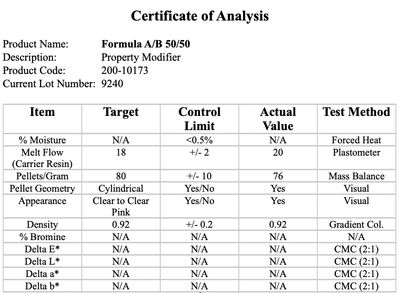
The Compound Manufacturer developed a custom property modifier masterbatch specifically engineered for the OEM's filtration media requirements. The formulation was designed to provide precise control over material properties critical to filtration performance, including melt flow characteristics, pellet geometry, density, and appearance. (See Appendix A for Quality Specifications Table)
The technical development focused on creating a polypropylene-based matrix that would enable time-release functionality of the proprietary liquid antioxidant blend. The pellets were engineered to release minute quantities of the antioxidant system when contacted by oil or fuel, providing continuous preservation of fluid life range throughout the service interval. The novel approach to incorporating the liquid antioxidant ensured uniform dispersion throughout the polymer matrix, enabling consistent release characteristics across the pellet population.
5.2 Quality Assurance Protocol
The Compound Manufacturer implemented comprehensive quality control procedures for each production lot. Certificate of Analysis documentation accompanied every shipment, providing actual test values against specification targets. Quality assurance oversight by designated personnel ensured consistent application of test methodologies and documentation standards.
The quality protocol included verification of pellet geometry and appearance through visual inspection, density measurement via gradient column methodology, melt flow characterization using plastometer testing, and pellet count consistency via mass balance determination. These quality parameters were critical to ensuring consistent time-release behavior and proper integration into the OEM's filtration media manufacturing process.
5.3 Supply Chain Operations
The supply relationship operated on standard commercial terms with established minimum order quantities, freight terms, and payment conditions. The Compound Manufacturer maintained manufacturing capacity to fulfill recurring orders with consistent lead times.
Packaging and handling protocols ensured material protection during shipment and storage. Flexible packaging options accommodated varying customer requirements, with standard packaging and specialized container options available.
6. Technical Outcomes and Relationship Evolution
6.1 Quality Performance
The collaborative supply relationship achieved consistent quality performance across multiple production lots over several years. Certificate of Analysis documentation demonstrated actual values consistently within established control limits, verifying manufacturing process control and raw material consistency.
Melt flow characteristics remained stable within specification ranges, ensuring processing consistency in the OEM's manufacturing operations. Pellet geometry and appearance standards were maintained, facilitating uniform dispersion and handling in downstream applications. Density specifications were achieved reliably, contributing to consistent final product performance and predictable time-release characteristics.
6.2 Supply Reliability
The multi-year collaboration demonstrated sustained supply chain performance with reliable delivery of qualified materials. The Compound Manufacturer maintained technical support capabilities, providing direct access to quality assurance personnel for inquiry resolution.
The relationship evolved from initial qualification through steady-state supply, with both parties fulfilling contractual obligations regarding confidentiality, quality standards, and commercial terms.
6.3 Commercial Continuation and Long-Term Partnership
The supply relationship continued through the contractual period with recurring orders and consistent quality performance. The collaboration achieved its operational objectives of providing reliable, qualified material supply for the OEM's filtration system manufacturing.
Following the initial project period (2011-2014), the Compound Manufacturer has enjoyed commercial business with the OEM for the last 14 years, and this commercial business continues to this day. This sustained relationship demonstrates the long-term viability of the technical solution and the strength of the collaborative partnership. The continued supply of the time-release additive system underscores the OEM's confidence in the Compound Manufacturer's ability to maintain quality, consistency, and technical performance over an extended commercial timeframe.
7. Discussion and Analysis
7.1 Quality Assurance in Specialty Supply
This case illustrates the critical role of documented quality control in specialty chemical supply relationships. The Certificate of Analysis protocol provided the OEM with verifiable evidence of material conformance to specifications, enabling confident use in critical filtration applications. The multi-parameter testing approach—encompassing physical, visual, and processing characteristics—addressed the diverse requirements of thermoplastic additive performance.
The maintenance of quality over multiple years and production lots demonstrated manufacturing process maturity and raw material sourcing consistency essential for industrial applications where batch variation could compromise end-product performance. The 14-year commercial continuation validates the long-term stability of the quality assurance systems implemented.
7.2 Technical Innovation in Liquid Additive Incorporation
The case demonstrates how technical capabilities in handling challenging materials can create sustainable competitive advantage. The Compound Manufacturer's novel approach to incorporating liquid antioxidants into a polypropylene matrix addressed a significant technical barrier that limits many compounders. This capability enabled the development of a functional time-release system that provides continuous antioxidant protection to fluids passing through the filtration media.
The ability to uniformly disperse liquid additives into a solid polymer matrix, while maintaining pellet integrity and controlled release characteristics, represents a specialized compounding expertise that supported both the initial engagement and the sustained commercial relationship.
7.3 Confidentiality Frameworks in Supply Relationships
The Mutual Confidentiality Agreement enabled open technical collaboration regarding application requirements and material capabilities while protecting proprietary formulation knowledge. The agreement's specific provisions regarding samples, reverse engineering, and publication restrictions reflect standard practices in specialty chemical markets where formulation intellectual property represents core competitive advantage.
The survival of confidentiality obligations beyond the agreement term ensured continued protection of disclosed information even after commercial relationships concluded, aligning with industry norms for trade secret protection.
7.4 Sustained Collaboration Dynamics
The case demonstrates characteristics of successful long-term supply relationships in specialty materials:
Technical Alignment: The Compound Manufacturer's capability to meet precise specifications aligned with the OEM's quality requirements, creating foundation for sustained supply. The specialized expertise in liquid additive incorporation provided unique value that supported long-term partnership.
Operational Reliability: Consistent fulfillment of orders with documented quality enabled the OEM to maintain manufacturing schedules without material-related disruptions over 14 years of commercial operation.
Governance Structure: The confidentiality framework provided sufficient protection to enable information exchange while preserving competitive interests of both parties.
Value Creation: The time-release functionality delivered measurable performance benefits to the OEM's filtration systems, creating mutual value that sustained the commercial relationship beyond the initial project scope.
7.5 Limitations and Constraints
The case also reveals constraints inherent in specialty supply relationships. The reliance on specific formulations created potential supply continuity considerations, though the 14-year collaboration duration demonstrated effective risk mitigation. Market conditions and organizational changes on either party could influence relationship continuation regardless of technical performance. The specialized nature of the liquid additive incorporation technology may limit alternative supply options, reinforcing the importance of the sustained partnership.
8. Conclusions and Implications
8.1 Key Findings
This case study demonstrates that: (1) Rigorous quality assurance protocols with comprehensive documentation enable reliable supply of specialty thermoplastic additives for demanding industrial filtration applications; (2) Confidentiality frameworks facilitate sustained technical collaboration while protecting proprietary formulation knowledge essential to competitive positioning; (3) Multi-year supply relationships can achieve consistent quality performance through mature manufacturing processes and dedicated quality oversight; (4) Collaborative partnerships between specialty compound manufacturers and filtration system OEMs support reliable material supply for safety-critical applications; (5) Documented quality control and traceability meet industrial customer requirements for material verification and regulatory compliance support; (6) Technical capabilities in handling difficult-to-process liquid additives can create sustainable competitive advantage and enable innovative time-release functionality; and (7) Successful initial collaboration can evolve into sustained commercial relationships spanning 14+ years when technical performance and operational reliability meet customer requirements.
8.2 Industry Implications
For specialty compound manufacturers, this case underscores: the competitive importance of quality assurance capabilities and documentation protocols in industrial markets; the value of confidentiality frameworks that enable customer collaboration while preserving intellectual property; the benefits of sustained customer relationships in specialty chemical markets characterized by qualification requirements and switching costs; and the strategic advantage of developing specialized capabilities in handling challenging materials such as liquid additives.
For filtration system manufacturers, the case highlights: the feasibility of securing reliable supply of specialized additives through collaborative supplier relationships; the importance of quality documentation for material verification and traceability; the role of confidentiality protections in enabling open technical dialogue regarding application requirements; and the potential for time-release additive systems to enhance product performance and differentiation.
For the broader industrial materials sector, the case contributes to understanding governance mechanisms for supply relationships involving proprietary technologies, demonstrating how contractual frameworks can balance information sharing needs with competitive protection requirements. The 14-year commercial continuation provides evidence that well-structured collaborative relationships can deliver sustained value in specialty chemical markets.
8.3 Future Research Directions
This case suggests several avenues for subsequent investigation: longitudinal analysis of quality performance trends in long-term specialty chemical supply relationships; comparative examination of confidentiality framework provisions across different industrial sectors and their impact on collaboration depth; analysis of supply relationship resilience under market stress or organizational change conditions; investigation of quality documentation digitization and blockchain applications for enhanced supply chain traceability; and examination of time-release additive mechanisms in polymer matrices for controlled release applications in filtration and other industrial sectors.
References
Bessen, J., & Meurer, M. J. (2008). Patent failure: How judges, bureaucrats, and lawyers put innovators at risk. Princeton University Press.
Eisenhardt, K. M. (1989). Building theories from case study research. Academy of Management Review, 14(4), 532–550.
Fitch, J. C. (2001). The role of filtration in lubrication system maintenance. Machinery Lubrication.
Grellmann, W., & Seidler, S. (2007). Polymer testing. Hanser Publishers.
Vogel, H. (1996). Polymer materials: Structure and properties. CRC Press.
Williamson, M. P., Lavelle, J. P., & Dellinger, E. L. (1990). Bypass oil filtration for engine durability. SAE Transactions, 1–10.
Yin, R. K. (2018). Case study research and applications: Design and methods (6th ed.). SAGE Publications.
Author Note: This case study was prepared using primary source documentation while maintaining confidentiality of proprietary information as specified in applicable proprietary information agreements. Company names, product codes, specific formulation details, and commercial terms have been anonymized to protect competitive and confidential information.