Construction (Case Study)
Academic Case Study: Development of Flame-Retardant Polypropylene Compounds for Construction Geosynthetics
A Case Study in Collaborative Materials Development for Building Applications
Authors: Howard Bradshaw and Thomas A. Guerriero, PhD
Abstract
This case study examines a multi-year collaborative development initiative between a specialty thermoplastic compound manufacturer (hereinafter "the Compound Manufacturer") and a manufacturer of geocomposite drainage systems and building materials (hereinafter "the OEM"). The project, conducted from December 2018 through 2021, focused on developing non-halogenated, flame-retardant polypropylene masterbatch compounds for thermoformed geosynthetic drainage products used in building construction and civil engineering applications. The collaboration achieved significant technical milestones, including successful European fire classification to B-s1,d0 standard and production-scale manufacturing trials, demonstrating the feasibility of replacing conventional materials with enhanced fire-performance alternatives. The case illustrates the iterative nature of formulation development for construction applications, the importance of processing-property optimization, and the pathway from laboratory development to commercial fire classification and production implementation.
Keywords: flame-retardant polymers, construction geosynthetics, building materials, fire classification, polypropylene, intumescent technology, thermoforming, EN 13501-1, collaborative R&D
1. Introduction and Industry Context
1.1 Fire Safety in Construction Geosynthetics
Modern building construction increasingly demands materials that combine functional performance with enhanced fire safety characteristics. Geocomposite drainage systems—multi-layer materials incorporating dimpled or cuspated polymer cores with geotextile filters—play critical roles in building envelope moisture management, foundation drainage, and infrastructure waterproofing (Koerner, 2012). These applications require materials that maintain mechanical performance under soil loading and environmental exposure, chemical resistance to groundwater and soil constituents, processability for high-volume thermoforming manufacturing, and fire performance meeting increasingly stringent building code requirements. Polypropylene has become the material of choice for drainage core applications due to its favorable cost-performance profile, chemical resistance, and thermoforming characteristics. However, conventional polypropylene is highly flammable, necessitating flame-retardant modification for applications where fire performance is regulated (Levchik & Weil, 2006).
1.2 Regulatory Drivers for Enhanced Fire Performance
European construction markets operate under harmonized fire classification standards that significantly influence material selection. EN 13501-1:2019 establishes reaction-to-fire classifications for construction products, with Class B representing "very limited contribution to fire"—a stringent requirement for many building applications (European Committee for Standardization, 2019). The classification system evaluates fire growth rate (FIGRA), total heat release (THR), smoke production (SMOGRA, TSP), and flaming droplet formation. Achieving B-s1,d0 classification—indicating Class B fire performance with minimal smoke (s1) and no flaming droplets (d0)—represents a significant technical achievement for polyolefin-based materials, particularly in thin-section thermoformed applications where material mass limits char formation capacity.
1.3 Research Objectives
This case study analyzes the collaborative development process for a flame-retardant polypropylene masterbatch system designed for thermoformed geosynthetic drainage cores. The research questions include: What formulation approaches enable development of flame-retardant polypropylene meeting stringent European fire classification standards for construction applications? How do processing characteristics and material morphology interact to influence both fire performance and mechanical properties in thermoformed products? What iterative development processes are required to optimize compounds for specific manufacturing processes and end-use requirements? How can collaborative relationships between compound manufacturers and materials processors facilitate successful technology transfer from laboratory to production?
2. Methodology and Data Sources
This case study employs qualitative, document-based research methodology drawing upon primary source materials including: Mutual Confidentiality Agreement (December 2018); Technical quotation correspondence (October 2021); Production trial documentation (March 2021); Third-party fire classification reports (December 2021); and Internal technical documentation. The analysis maintains confidentiality of proprietary formulation details through anonymization of specific additive packages and processing parameters, consistent with the confidentiality obligations documented in the underlying agreements.
3. Case Background and Organizational Context
3.1 The Compound Manufacturer Profile
The Compound Manufacturer operated as a specialty thermoplastic compounder with particular expertise in intumescent flame-retardant systems for polyolefin applications. Based in the southeastern United States, the organization had developed proprietary additive technologies (internally designated as "VersaCHAR") enabling polypropylene compounds to achieve exceptional flame-retardant performance without halogenated additives. Key technical capabilities included intumescent flame-retardant masterbatch formulation, polypropylene modification for enhanced thermal and mechanical properties, processing aid development for manufacturing optimization, and application-specific compound customization. The company's technology platform emphasized "clean" flame-retardant solutions, positioning its products as environmentally preferable alternatives to conventional halogenated systems.
3.2 The OEM Profile
The OEM specialized in manufacturing geocomposite drainage systems for building construction and civil engineering applications, including foundation waterproofing and drainage systems, sub-surface drainage for infrastructure, and moisture management for building envelopes. The organization operated thermoforming production lines capable of processing polypropylene into dimpled or cuspated core structures at widths up to 8 feet, with integrated fabric lamination capabilities. The OEM's market position required materials that could meet diverse regional fire performance regulations, including increasingly stringent European requirements for exported products.
3.3 Initial Engagement
The collaboration originated from the OEM's need to enhance fire performance of their polypropylene drainage core products for European market access. Initial discussions focused on developing a masterbatch system that could be let down at 100% (used neat) or in appropriate carrier resins, processed on existing thermoforming equipment without significant modification, qualified to European fire classification standards, and manufactured at commercial scale with consistent quality. The engagement moved from initial confidentiality agreement to active development over approximately two years, reflecting the iterative nature of formulation optimization for this demanding application.
4. Collaborative Framework and Governance
4.1 Confidentiality Agreement
The collaboration operated under a Mutual Confidentiality Agreement executed in December 2018. This agreement established the legal framework for information exchange while protecting each party's proprietary interests. Key provisions included: Definition of Confidential Information encompassing all technical, engineering, operational, business, and economic information, specifically including formulations and additive packages, processing conditions and equipment, product samples and production quantities, and terms and nature of the collaborative relationship. Use Limitations restricted information to evaluation of formulated polymers for potential commercial trade, with specific prohibition on reverse engineering except as necessary for determining material suitability. The agreement established a five-year term with confidentiality obligations surviving for an additional five years. The agreement explicitly preserved all intellectual property rights, with neither party constrained from developing independent innovations.
4.2 Governance Structure
The collaboration operated through direct technical engagement between the Compound Manufacturer's development team and the OEM's production engineering and quality personnel. The iterative development process involved multiple trial phases, with the Compound Manufacturer producing modified formulations in response to processing feedback and performance testing results.
5. Technical Development and Production Implementation
5.1 Formulation Development Approach
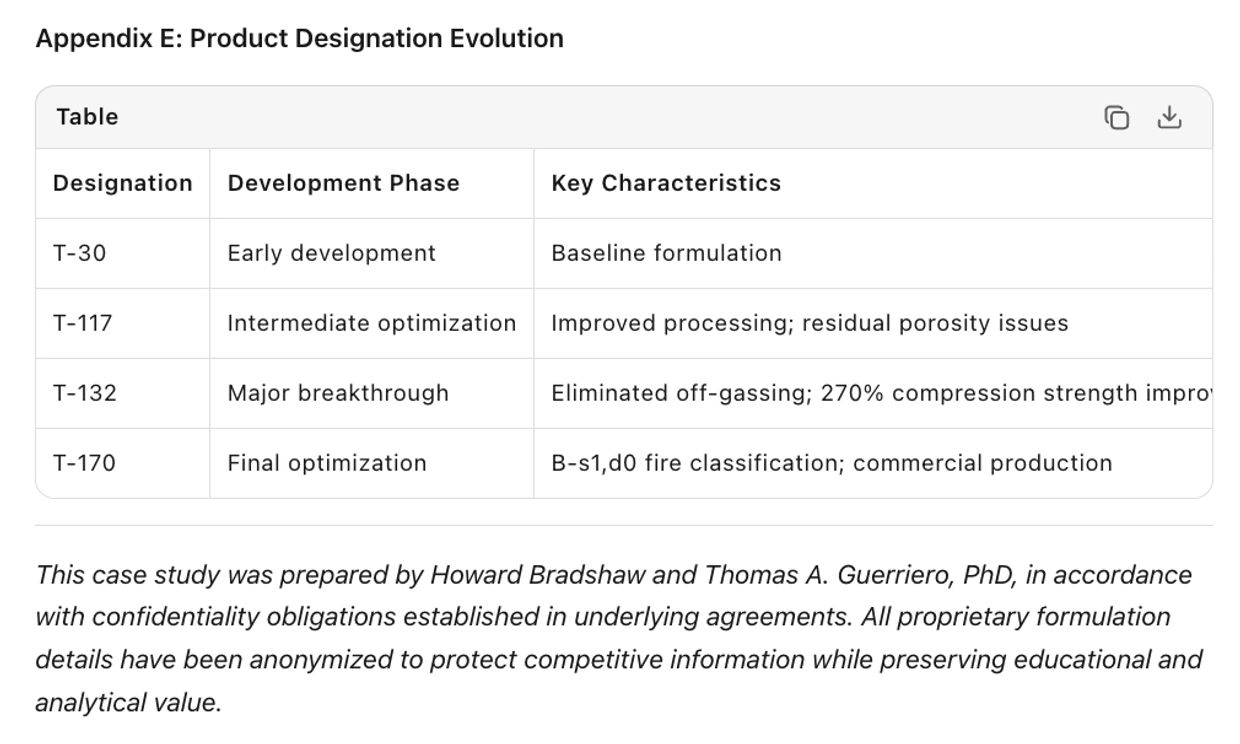
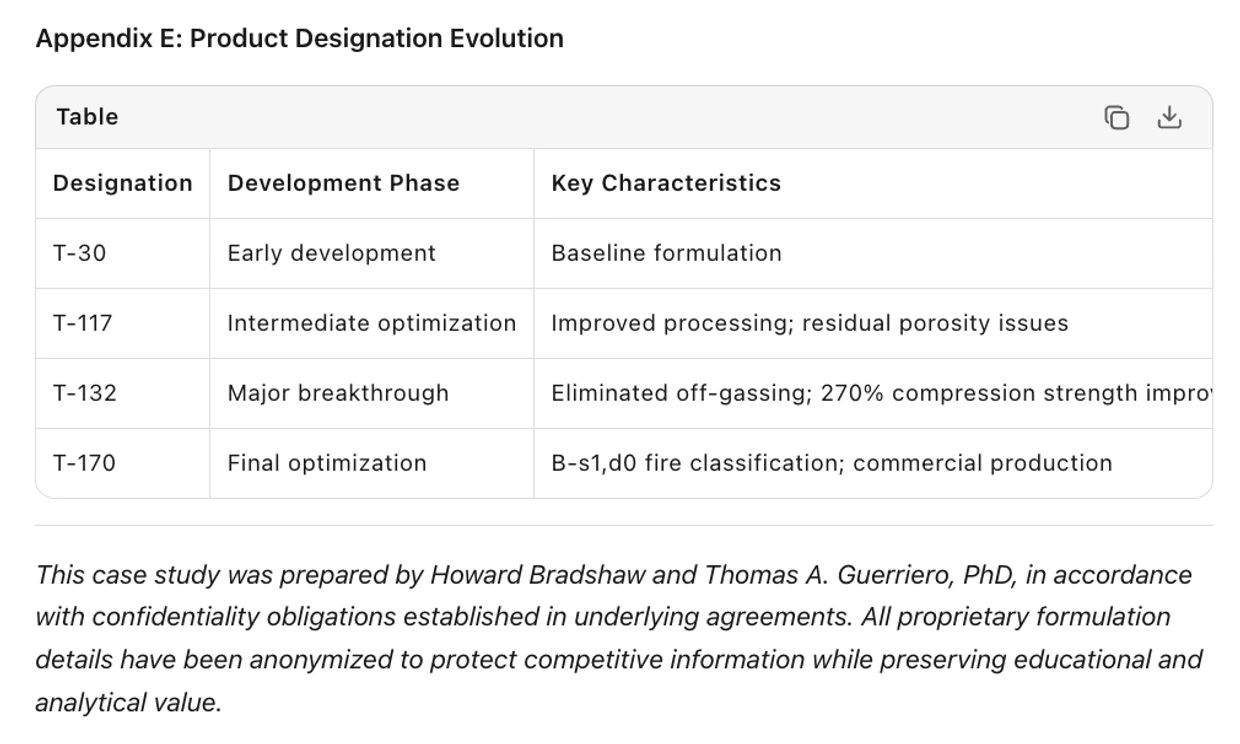
The Compound Manufacturer developed a series of masterbatch formulations based on their proprietary intumescent flame-retardant technology platform. The formulation approach incorporated polypropylene carrier resin for compatibility with OEM's processing, intumescent additive system providing char formation and flame suppression, processing aids for thermoforming optimization, and stabilization package for manufacturing and end-use durability. Development compounds were designated with product codes PAL VersaCHAR T-30, T-117, T-132, and T-170, representing progressive optimization iterations.
5.2 Production Trial Methodology
The qualification program involved multiple production trials on the OEM's wide-line thermoforming equipment. A representative trial (Trial #8, March 2021) with the T-132 formulation illustrates the development process.
Equipment Configuration included Wide Line with European dimple-forming drum, 8-foot product width capability, and vacuum forming onto temperature-regulated drum.
Material Specifications included Product PAL VersaCHAR T-132 Masterbatch, melt index of 9.8 g/10 min (manufacturer specification), and vacuum-sealed aluminized bag packaging for moisture protection.
The Process Protocol involved: purging extruder with virgin polypropylene; conditioning extruder/die with processing aid masterbatch at 2% in virgin PP; transitioning to trial material to establish continuous 8-foot sheet; forming dimpled core at target thickness of 25 mil (0.635 mm); and collecting sample rolls for laboratory evaluation.
5.3 Processing and Quality Results
The T-132 trial demonstrated substantially improved processing characteristics compared to earlier formulations. Detailed results are provided in Appendix B.
The dramatic improvement in compression strength (270% increase) resulted from elimination of porosity caused by off-gassing in earlier formulations. The T-132 compound produced dense, void-free dimple walls that significantly enhanced mechanical performance while maintaining target thickness and weight specifications.
Visual inspection confirmed quality improvements including smooth vacuum-formed surface with no bubbles or holes from off-gassing, textured top surface with consistent fine texture from forming process, and clean die exit with minimal buildup compared to previous trials.
5.4 Fire Classification Achievement
The optimized formulation (T-170 variant) achieved third-party fire classification testing in accordance with EN 13501-1:2019. Testing was conducted in November 2021, with classification report issued December 2021.
Test Methods included UNE-EN ISO 11925-2:2021 (Ignitability) and EN 13823:2020 (Single Burning Item test). Detailed classification results are provided in Appendix C.
The Final Classification of B-s1,d0 represents the highest achievable rating for polyolefin-based materials under EN 13501-1, indicating: B for very limited contribution to fire, s1 for no or very limited smoke production, and d0 for no flaming droplets or particles.
The classification is valid for the product mechanically fixed to calcium silicate substrate (Class A1 or A2-s1,d0) with no ventilated air gap.
6. Commercial Implementation
6.2 Technical Positioning
The commercial products were positioned as 100% let-down masterbatch compounds, simplifying OEM processing by eliminating blending requirements. The "PAL...The Clean Plastic" branding emphasized environmental positioning of the non-halogenated flame-retardant systems.
7. Discussion and Analysis
7.1 Iterative Formulation Optimization
The progression from T-30 through T-170 demonstrates characteristic patterns in specialty compounding development.
The T-117 to T-132 evolution represented the most significant technical breakthrough, involving elimination of off-gassing during thermoforming. Earlier formulations exhibited moisture sensitivity or additive decomposition that created porosity, compromising mechanical properties. The T-132 formulation achieved "dryer" processing characteristics, yielding dense, high-strength product structures.
Property trade-off management balanced competing requirements: fire performance through intumescent additive loading; processability through melt flow characteristics; mechanical properties through density and compression strength; and cost through additive efficiency. The T-170 optimization achieved B-s1,d0 classification while maintaining processability, representing the commercially preferred solution.
7.2 Manufacturing Scale-up Challenges
The production trials reveal critical scale-up considerations for specialty compounds.
Equipment Conditioning required dedicated purging and conditioning protocols, indicating sensitivity of flame-retardant formulations to equipment history and contamination.
Process Parameter Sensitivity required careful control of extruder temperature profiles, melt pressure and gear pump settings, forming drum temperature and vacuum levels, and line speed for thickness control.
Quality Verification incorporated comprehensive testing: melt index, dimensional verification, weight consistency, and compression strength per ASTM D6364.
7.3 Fire Performance Achievement
The B-s1,d0 classification achievement is technically significant for several reasons.
Material Challenge: Polypropylene's inherent flammability makes Class B achievement difficult, particularly in thin sections (0.72 mm tested) where char barrier formation is limited.
Test Severity: The Single Burning Item test subjects specimens to a substantial ignition source, with classification based on comprehensive heat release, flame spread, smoke, and droplet metrics.
Regulatory Value: B-s1,d0 classification enables market access for construction applications across European jurisdictions, supporting building code compliance for the OEM's drainage products.
7.4 Collaborative Development Value
The case illustrates benefits of sustained supplier-customer collaboration.
The Feedback Loop enabled production trial results to directly inform formulation modifications, with the OEM's processing expertise guiding Compound Manufacturer optimization priorities.
Shared Investment through multiple trial phases represented mutual commitment to development success, with both parties investing resources beyond typical transactional supply relationships.
Technical Integration was demonstrated by the Compound Manufacturer's development of processing aids specifically for the OEM's equipment, showing application-specific customization capability.
8. Conclusions and Implications
8.1 Key Findings
This case study demonstrates that: (1) Non-halogenated intumescent polypropylene compounds can achieve highest-tier European fire classification (B-s1,d0) for construction applications, enabling regulatory compliance and market access; (2) Formulation optimization requires iterative development balancing fire performance, processability, and mechanical properties, with manufacturing-scale trials essential for identifying processing characteristics not apparent in laboratory evaluation; (3) Processing-property relationships are critical in thermoformed applications, with off-gassing and porosity control significantly influencing mechanical performance independent of nominal material specifications; (4) Sustained collaborative relationships between compound manufacturers and materials processors facilitate successful technology transfer from laboratory development to commercial production and third-party certification; and (5) Masterbatch delivery systems at 100% let-down simplify OEM manufacturing while enabling formulation complexity that would be impractical with conventional blending approaches.
8.2 Industry Implications
For specialty compound manufacturers, this case underscores: the value of platform technologies adaptable to diverse application requirements; the necessity of manufacturing-scale trial capabilities or partnerships for construction market development; and the competitive advantage of third-party certification achievement in regulated markets.
For construction materials manufacturers, the case highlights: the feasibility of enhancing fire performance without compromising mechanical properties or processing efficiency; the importance of collaborative development for complex formulation integration; and the market access value of European harmonized standard compliance.
For the broader construction industry, the case contributes to understanding implementation pathways for enhanced fire performance materials, demonstrating that regulatory compliance and technical performance can be achieved with environmentally preferable non-halogenated systems.
8.3 Future Research Directions
This case suggests several avenues for subsequent investigation: long-term performance studies of intumescent polypropylene geosynthetics under field exposure conditions; comparative life-cycle assessment of halogenated versus non-halogenated flame-retardant systems in construction applications; processing optimization studies for alternative thermoforming configurations and product geometries; and expansion of certification scope to additional construction product categories and regional regulatory systems.
References
European Committee for Standardization. (2019). EN 13501-1:2019: Fire classification of construction products and building elements—Part 1: Classification using data from reaction to fire tests. CEN.
Koerner, R. M. (2012). Designing with geosynthetics (6th ed.). Xlibris Corporation.
Levchik, S. V., & Weil, E. D. (2006). A review of recent progress in phosphorus-based flame retardants. Journal of Fire Sciences, 24(5), 345–364.

Appendix A - Timeline of Key Events

Appendix B

Appendix C

Appendix D
Appendix E